


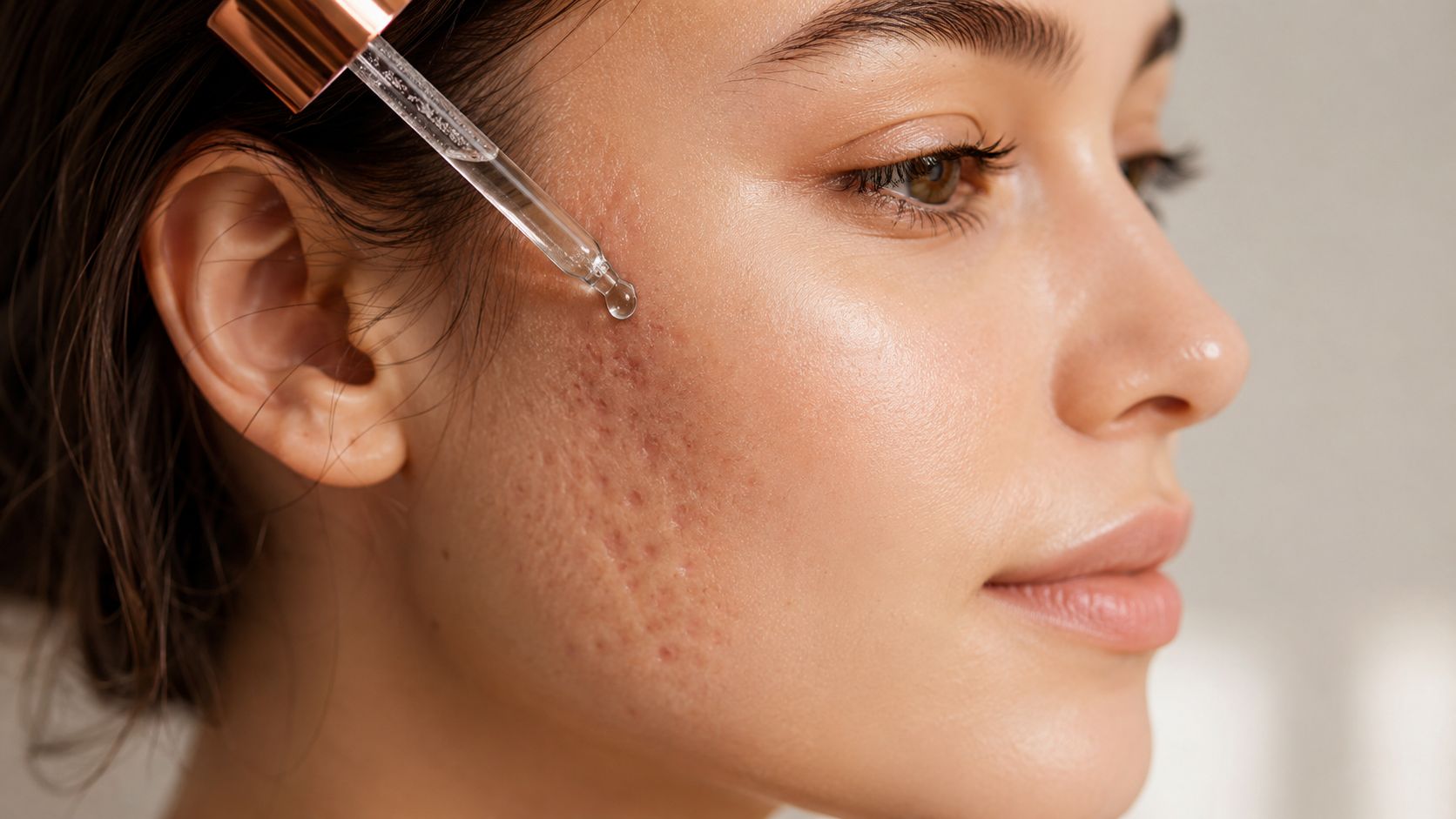
You're probably here because the breakouts have slowed down, but your mirror still isn't giving you a break. The pimples are gone, yet the dents, uneven texture, or lingering dark marks keep catching the light. In Southwest Florida, that frustration gets amplified. Heat can keep skin reactive, humidity can fuel congestion, and strong sun can make every post-breakout mark look darker and last longer.
That's why acne facial scar treatment needs a different kind of plan than acne treatment alone. Scar revision is less about “drying out” the skin and more about rebuilding texture, calming pigment, protecting healing skin, and choosing the right level of treatment for the specific conditions on your face. Some concerns respond well to studio-based resurfacing and supportive facials. Others need deeper medical procedures like laser resurfacing, subcision, or punch techniques. The good news is that there are more options than ever. The global acne scar treatment market was valued at US$ 6 billion in 2020 and is projected to reach US$ 10.8 billion by 2031, which reflects how widespread this concern is and how much treatment innovation has expanded, according to Transparency Market Research on the acne scar treatment market.
Table of Contents
- The Journey Beyond the Breakout
- Identifying Your Acne Scar Type
- Your In-Studio Treatment Blueprint
- The Florida Factor in Scar Treatment
- Building a Supportive At-Home Routine
- The Path to Smoother Skin and Realistic Timelines
- Acne Scar Treatment FAQs
The Journey Beyond the Breakout
A lot of clients sit down for their first scar consultation and say some version of the same thing. “I thought once the acne stopped, my skin would go back to normal.” That's the emotional part of acne scarring that often gets overlooked. The active breakout phase feels temporary. The marks left behind can feel stubborn, unfair, and much harder to decode.

Some people are dealing with shallow roughness that makes foundation sit unevenly. Others have deeper indents along the cheeks that become obvious in outdoor light. In Fort Myers, Punta Gorda, and nearby communities, I also see many clients whose scars look worse after beach days, driving with sun exposure on one side of the face, or repeated heat-related flare-ups that keep inflammation active.
The emotional shift
The first shift is understanding that scars are treatable even if they aren't erased overnight. Good acne facial scar treatment is rarely one dramatic appointment. It's a process of improving texture, softening contrast, reducing congestion that triggers new marks, and protecting your skin while collagen remodeling happens.
Acne scars usually improve in layers. First the skin looks calmer, then smoother, then more even under natural light.
That kind of progress matters. It's visible, it's meaningful, and it's often what restores confidence.
Why a guided plan matters
Scar treatment works best when the plan matches the scar type, your current breakouts, your skin sensitivity, and your environment. That last piece matters more in Southwest Florida than many people realize. A treatment that looks simple on paper can create unnecessary irritation or pigmentation issues if it's timed badly for a week of strong sun exposure and outdoor activity.
A thoughtful studio approach doesn't promise perfection. It gives you a roadmap. That may start with calming the skin barrier and improving superficial texture. It may later involve referrals for deeper medical procedures if your scars are tethered, narrow, or severely atrophic. Either way, progress is possible, and that's where relief often begins.
Identifying Your Acne Scar Type
Before choosing products, peels, or resurfacing, you need to know whether you're looking at true scars, pigment, or both. Many people lose time this way. They buy brightening products for dents, or they chase aggressive treatments for marks that are mostly discoloration.

Texture versus color
Run clean fingertips across the area in good light. If the surface feels uneven, pitted, ridged, or raised, you're likely dealing with textural scarring. If the skin feels smooth but looks brown, red, or gray-toned, that's usually post-inflammatory hyperpigmentation or post-breakout discoloration rather than a structural scar.
This distinction changes everything. Pigment often responds well to brightening care, gentle exfoliation, SPF discipline, and climate-aware facials. True textural scars usually need collagen-focused procedures.
For some clients, a consultation facial like Radiant Glow Clinic Grade Facial With Personalized Skin Consultation For All Skin Types is useful as a first step because it pairs a personalized skin consultation with deep cleansing, gentle exfoliation, professional extraction care when needed, and SPF finishing protection. That type of session doesn't replace deeper scar revision, but it can help clarify whether you're dealing with congestion, dullness, pigment, sensitivity, or early textural change.
The road-surface analogy
Think of scar types like damage on a road.
- Ice pick scars are like narrow, deep punctures. They look small from above but drop sharply into the skin.
- Boxcar scars are broader depressions with more defined edges, like square potholes.
- Rolling scars create soft waves and shadowing, like a road surface with shallow dips underneath.
- Hypertrophic or keloid scars are raised rather than indented. They come from excess collagen during healing.
Here's a quick visual guide before you watch a more detailed explanation:
What that means for treatment choices
Atrophic scars, which are the indented types, are often the ones that benefit most from collagen induction or resurfacing. Raised scars follow a different path and need a different strategy. Flat pigment needs yet another approach.
Practical rule: If the concern changes with lighting and shadows, texture is involved. If it mostly changes with tanning or inflammation, pigment is usually part of the picture.
A good consultation should identify each scar type separately, not label everything “acne scars.” Most faces are mixed. You might have rolling scars on the cheeks, dark marks near the jawline, and active congestion across the nose. That's why one-size-fits-all treatment usually disappoints.
Your In-Studio Treatment Blueprint
Professional acne facial scar treatment works best when you match the tool to the depth of the problem. Surface roughness, congestion, dullness, and mild discoloration can often be improved in a studio setting. Deep atrophic scars usually need more intensive medical procedures, sometimes in combination.
What studio treatments can realistically do
A licensed esthetician can improve the skin environment that makes scars look more obvious. That includes reducing congestion, smoothing accumulated dead skin, supporting barrier repair, and keeping post-breakout pigment from getting worse. In a studio, that often means a mix of gentle chemical peels, microdermabrasion, LED facial therapy, targeted extractions, and customized aftercare.
These treatments are useful when skin is reactive, humid-weather breakouts are still happening, or the client isn't ready for aggressive downtime. They can also help prep the skin before deeper resurfacing elsewhere.
A resurfacing-focused facial can fit well here, especially if your main complaints are roughness, clogged pores, and uneven tone. If you want a local explanation of how that category works, Lumina's guide to what a resurfacing facial treatment is in Florida breaks down the studio side of controlled exfoliation in a way that's practical for this climate.
When deeper procedures enter the conversation
For established atrophic scarring, medical literature is clear that stronger interventions often produce the biggest structural change. Clinical data shows that CO2 laser resurfacing can produce 50% to 80% improvement in facial atrophic acne scars, and a series of 30% salicylic acid peels has also been described as highly efficacious in the review summarized by the Journal of Cutaneous and Aesthetic Surgery article on acne scars and treatment options.
That doesn't mean everyone should jump straight to laser. It means deep scars usually won't respond enough to cleansing facials and home serums alone.
For clients comparing options, I often separate treatments into three buckets:
- Supportive studio care for congestion, pigment support, and mild texture
- Collagen-focused procedures such as microneedling or RF microneedling when appropriate through qualified providers
- Resurfacing or surgical-style correction for deeper boxcar, rolling, or ice pick scars, often through dermatology or medical aesthetics
If you want another practitioner-written overview of effective acne scar treatments, that resource is useful for seeing how different modalities get paired based on scar depth.
Professional acne scar treatment comparison
| Treatment Modality | Best For Scar Types | Typical Downtime | Recommended Sessions |
|---|---|---|---|
| Gentle chemical peels | PIH, shallow texture, roughness, congestion-related post-acne changes | Mild visible flaking or little downtime, depending on peel depth | Usually done as a series based on response |
| Microdermabrasion | Surface roughness, dull buildup, mild uneven texture | Minimal downtime if skin barrier is healthy | Best repeated over time rather than as a one-off |
| LED facial therapy | Inflamed skin, healing support, redness-prone post-breakout skin | No true downtime | Often layered into an ongoing plan |
| Microneedling | Mild to moderate atrophic scars, especially rolling or boxcar patterns | Short recovery with temporary redness | Usually requires multiple sessions |
| Radiofrequency microneedling | Atrophic scars when more remodeling is needed | More noticeable recovery than LED or basic facials | Usually performed in a series |
| Fractional CO2 or Er:YAG laser | Moderate to deep atrophic scars | Significant downtime compared with facials or peels | Determined by medical provider and scar severity |
| Subcision or punch techniques | Tethered rolling scars or selected ice pick scars | Variable and procedure-dependent | Often part of a combination plan |
Trade-offs clients should know
No treatment gives every scar type the same result. A peel can brighten a dark mark and slightly refine superficial texture, but it won't physically release a tethered rolling scar. Microdermabrasion can make skin feel smoother, but it won't reach deep enough for narrow ice pick scarring. Laser can produce substantial change, but recovery, heat sensitivity, and pigment risk matter, especially in Florida.
That's why the strongest plan is usually layered, not random. You control breakouts first. Then you address pigment and barrier health. Then you choose the appropriate level of collagen remodeling for what remains.
The Florida Factor in Scar Treatment
Southwest Florida changes the rules for acne facial scar treatment. Sun, heat, sweat, salt air, and year-round humidity affect both how scars form and how skin heals after treatment. Advice that sounds simple in a cooler climate can fail here fast.
Sun exposure changes the rules
Freshly treated skin is more vulnerable to darkening, irritation, and uneven healing. That matters even if you're not lying on the beach. Walking the dog, driving across Fort Myers in afternoon sun, sitting near windows, boating on the weekend, or spending time around reflective water all add up.
When a client has post-breakout marks that keep getting darker, the issue often isn't that treatment “isn't working.” It's that the skin keeps getting re-exposed before it stabilizes. That's especially true after exfoliating facials, peels, and any resurfacing-focused service.
For a local breakdown of how climate changes skin behavior, Lumina's article on skincare for Florida humidity is useful because it connects barrier care, congestion control, and weather in a very practical way.
Humidity complicates healing
Humidity doesn't always mean skin is hydrated. In practice, I see plenty of Florida clients with oily but dehydrated skin. They over-cleanse because they feel greasy, then the barrier gets irritated, then breakouts and discoloration linger longer. Add aggressive scar products on top, and the skin stays inflamed.
That's a bad setup for scar revision.
A climate-aware protocol usually includes:
- Careful scheduling so stronger exfoliation or resurfacing isn't placed right before major sun exposure
- Barrier-first aftercare because overheated, over-washed skin doesn't heal elegantly
- Sweat-aware product choices so sunscreen and moisturizers stay wearable in heat
- Breakout prevention because every new inflamed blemish can leave another mark
In Florida, aftercare isn't a side note. It's part of the treatment itself.
If your skin is scar-prone and acne-prone, the right plan often looks a little slower here. That's not a weakness in the protocol. It's how you protect results.
Building a Supportive At-Home Routine
Professional treatments do the heavy lifting, but your home routine determines how well your skin holds onto those gains. This is especially true after resurfacing, peels, or collagen-stimulating treatments.
Advanced treatments like fractional ablative lasers are considered first-line interventions for atrophic scars and can achieve up to 90% efficacy in clinical trials, while an at-home routine supports the healing and collagen remodeling those procedures start, according to the Frontiers in Medicine review on acne scar management.

A routine that supports remodeling
Keep the routine simple enough that you'll stick with it.
- Use a gentle cleanser. If your face feels tight after washing, it's probably too harsh. You want clean skin, not stripped skin.
- Add one remodeling active at a time. Retinoids are often useful for texture support and turnover. If your skin is sensitive, they need to be introduced carefully.
- Support with brightening and antioxidant care. Vitamin C can be helpful for overall tone support and daily environmental defense.
- Moisturize for barrier stability. A non-comedogenic moisturizer reduces the urge to overcompensate with harsh treatments.
- Wear broad-spectrum SPF every day. In Florida, this is the product that protects every other step.
If you've just had a facial or resurfacing-focused service, post-treatment skin usually benefits from fewer actives, not more. Lumina's guide to a post-facial skincare routine for lasting results is a good local reference for keeping aftercare realistic.
What to avoid while skin is healing
Many setbacks come from doing too much. Scar-prone skin often reacts badly to impatience.
- Don't stack exfoliants. Using acids, scrubs, and retinoids together can push your barrier into irritation.
- Don't pick healing blemishes. That's one of the fastest ways to create new discoloration and texture change.
- Don't chase dryness. Acne-prone doesn't mean your skin wants to be dehydrated.
- Don't skip SPF on cloudy days. Florida light still counts.
A strong home routine should feel steady, not dramatic. If your skin is constantly burning, peeling, or angry, the routine needs adjustment.
When home care is done well, it doesn't replace professional acne facial scar treatment. It makes the professional work hold.
The Path to Smoother Skin and Realistic Timelines
Results from acne scar treatment almost never arrive in one clean moment. Results are often noticed in stages. Makeup sits better. Side-lighting looks less harsh. The skin feels smoother before it looks dramatically different in photos.

What progress usually feels like
Early on, the biggest changes are often clarity, reduced congestion, and calmer pigment. Structural change takes longer because collagen remodeling is slow. That's one reason people abandon good plans too early. They expect scar tissue to behave like a temporary blemish.
For raised scars, supportive tools can sometimes be part of the conversation. In some cases outside facial acne scar pitting, products like silicon scar removal patches may be discussed for scar management support, though they are not a substitute for treating indented facial acne scars.
What counts as success
A realistic goal is visible improvement, not flawless poreless skin. That may mean softer boxcar edges, less shadowing in rolling scars, and fewer dark post-acne marks competing for attention.
Here's what I want clients to keep in mind:
- Meaningful change is cumulative. One session can start improvement, but scar revision usually depends on repetition.
- Mixed scar types need mixed strategies. Texture, pigment, and active acne don't resolve on the same timeline.
- Maintenance matters. Once skin improves, sun habits and breakout control protect that work.
Patience isn't passive in scar treatment. It's part of the method.
Acne Scar Treatment FAQs
Do acne scars go away with skincare alone
Dark marks can improve with good home care, but deeper indented scars usually don't smooth out from products alone. Topicals support the process. They rarely correct structural depressions by themselves.
Are acne scar treatments painful
That depends on the treatment depth. A gentle peel, LED session, or climate-adapted facial is usually very manageable. Microneedling, RF microneedling, and laser-based procedures are more intense and should be discussed thoroughly before booking.
Should I treat scars if I still break out
Usually, yes, but the first priority is controlling active acne and reducing inflammation. If you keep forming new lesions, it's hard to make lasting progress on older scars. A pore-clearing facial plan can be a better starting point than jumping straight into aggressive resurfacing.
What works best for deep cheek scars
Deep rolling, boxcar, or ice pick scars often need medical procedures such as laser resurfacing, subcision, punch techniques, or a combination approach. Studio care still helps by keeping the skin healthier and better prepared.
Why do my scars look darker in Florida
Sun exposure and heat can keep post-breakout discoloration active. Even when the texture hasn't changed, pigment can make scars look more severe. That's why SPF and timing matter so much here.
If you're ready for a clearer plan, Lumina Skin Sanctuary offers licensed esthetician care built for Southwest Florida skin. A personalized consultation can help you sort out what's scar tissue, what's pigment, what can improve in-studio, and when it makes sense to pair studio care with medical referral options.


