


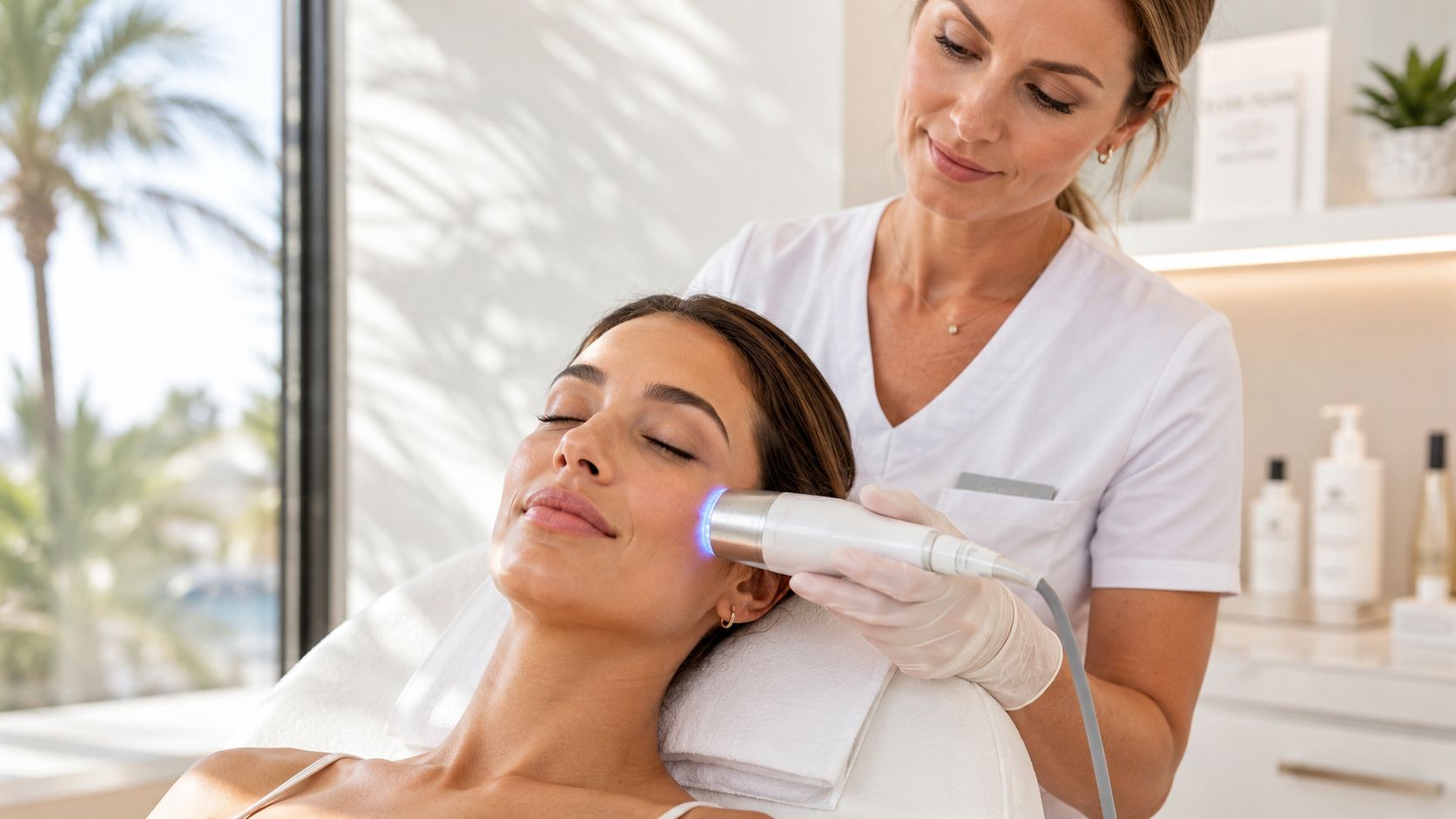
You're probably here because your skin still looks healthy, but it doesn't look as firm as it used to. In Fort Myers, that often shows up in a very specific way. The jawline softens a bit, the cheeks feel less springy, makeup doesn't sit as smoothly, and the mirror starts reflecting years of sun, heat, salt air, and air conditioning all at once.
That's a common Southwest Florida pattern. People enjoy beach days, golf, boating, walks in bright sun, and outdoor errands year-round. Then one day they search for a skin tightening facial near me because they want real improvement, not a dramatic change and not a risky recovery period.
Table of Contents
- Your Guide to Skin Tightening in Southwest Florida
- Beyond the Spa What Is a Clinic-Grade Skin Tightening Facial
- Your Skin Tightening Toolkit Modalities We Use at Lumina
- Real Results for Florida Skin Benefits and Realistic Outcomes
- The Lumina Experience From Consultation to Aftercare
- Find Your Perfect Treatment and Book Your Transformation
Your Guide to Skin Tightening in Southwest Florida
In Southwest Florida, skin aging rarely comes from one cause alone. It's usually a blend of UV exposure, repeated heat, dehydration from indoor cooling, and the everyday friction of sunscreen, sweat, and environmental exposure. That mix can leave skin looking looser, rougher, and more uneven long before someone feels ready for anything invasive.
A lot of local clients describe the same sequence. They feel fine about their skin in the morning, then see creasing, dullness, or softness around the lower face by midday. Others notice that their neck and jawline no longer match the energy they feel physically. That's often the point where they stop looking for a relaxing facial and start looking for a treatment plan with structure.
Skin tightening works best when the treatment matches both the skin condition and the climate the skin lives in every day.
That's where professional care becomes useful. In Fort Myers, climate-adaptive skin work matters because Florida skin isn't dealing with the same stress pattern as skin in cooler, drier places. Treatment choices, exfoliation level, barrier repair, and post-treatment sun strategy all need to reflect that.
If you're comparing local options, it helps to start with a practical checklist. This guide on what to look for in Fort Myers facials is a solid first step because the provider, the modalities, and the aftercare plan matter as much as the facial itself.
Beyond the Spa What Is a Clinic-Grade Skin Tightening Facial
A spa facial can feel wonderful. It can soften surface dryness, calm the nervous system, and give the skin a temporary fresh look. A clinic-grade skin tightening facial is different. It's built to create change below the surface by using controlled modalities, targeted products, and a treatment plan that supports collagen and elastin activity.
Think of it as a workout for your skin. A soothing facial is like stretching. Helpful, relaxing, and often worth doing. A tightening facial is closer to strength training. The goal isn't just to make the skin feel good that day. The goal is to stimulate a rebuilding response.

Why firmness changes over time
Skin loses some of its bounce as collagen and elastin support change with age, sun exposure, and genetics. In practice, that often looks like softer facial contours, fine lines that linger, and skin that doesn't rebound as quickly after squinting, smiling, or sleeping on one side.
Radio frequency skin tightening is one of the better-known non-surgical approaches because it uses heat to penetrate deeper skin layers and stimulate collagen, elastin, and new skin cells, according to the Cleveland Clinic overview of RF skin tightening. That's why these treatments are not instant-fix services. The skin needs time to build.
What makes it clinic-grade
Clinic-grade means the treatment is selected and adjusted for skin response, not just performed from a standard menu. The esthetician evaluates laxity, barrier condition, sun exposure habits, pigment risk, and whether the client needs lifting support, resurfacing, brightening, or a combination.
A strong treatment plan usually includes some version of these elements:
- Targeted stimulation: Heat, current, light, or ultrasound is used with a clear purpose.
- Controlled prep: Cleansing and exfoliation are chosen to improve penetration without overworking the barrier.
- Recovery support: Barrier-supportive finishing products and SPF aren't optional, especially in Florida.
- Series planning: One appointment can help, but structural improvement usually responds best to consistent treatment.
For people evaluating local treatment settings, this overview of how technology supports med spas and aesthetic clinics is useful context. It clarifies why results-oriented care depends on more than atmosphere.
One example of a multi-step tightening service is Youth-Restore, Sculpting and Firming Series. Based on the treatment snapshot, it combines mechanical cleansing, ozone steam, diamond microdermabrasion, high-frequency neon electrode therapy, thermal ultrasound wave infusion along the jawline, cheeks, and neck, a ceramide-infused firming mask, hydration mist, barrier cream, and SPF protection. That kind of sequencing is what separates a tightening protocol from a basic facial.
Your Skin Tightening Toolkit Modalities We Use at Lumina
In Fort Myers, skin rarely deals with one issue at a time. Sun exposure, heat, sweat, and indoor cooling can leave skin looking looser, duller, and more reactive all at once. That is why a professional tightening facial at Lumina is built by skin behavior, not by trend.

How each modality fits a different goal
Each modality has a job. The best plan depends on whether Florida skin needs calming, resurfacing, contour support, or better product penetration without triggering more inflammation.
| Modality | Best for | What it feels like | Trade-off |
|---|---|---|---|
| LED facial therapy | Skin that looks tired, inflamed, dull, or slow to recover | Gentle and comfortable | Subtle on its own, stronger as part of a broader plan |
| Microdermabrasion | Rough texture, buildup, and skin that needs smoother product penetration | Controlled exfoliation with a polished feel after | Too much exfoliation can backfire in heat-stressed skin, so restraint matters |
| Gentle chemical peels | Early photoaging, uneven tone, and surface roughness | Depends on formula, often warm or tingly | Not every peel is right before heavy sun exposure |
| Galvanic techniques | Deeper infusion of selected actives, especially for tone support and hydration balance | Mild electrical sensation or none at all | Ingredient choice matters as much as the current |
| Microcurrent or sculpting-focused work | Facial contour support and a more lifted look | Light stimulation and muscle-focused work | Best when used consistently and matched to anatomy |
Clients often ask which tool is best. The more useful question is which combination makes sense for skin that lives in Southwest Florida year-round.
For clients who want a better understanding of one supportive modality, this article on what LED facial treatment does for your skin explains where light-based support fits into a results-driven routine.
Practical rule: If looseness shows up with sun damage, dehydration, or uneven tone, tightening work looks better when those concerns are treated together.
That is where galvanic techniques can help. In practice, I use them to improve how well selected brightening or hydrating ingredients are delivered after proper prep, especially for clients whose skin looks flat or weathered from repeated UV exposure. For Southwest Florida skin, that matters. Tightening a dry, pigment-prone surface without addressing tone and barrier condition rarely gives a polished result.
When a series makes more sense than a single facial
A single treatment can leave skin smoother, fresher, and more refined for the short term. Firmer contours usually come from repetition.
For someone who wants a skin tightening facial near me because the jawline feels softer or the cheeks look less supported, a treatment series is usually the more honest recommendation. Skin tightening works best when the skin has time to respond, recover, and be treated again at the right interval.
Radiofrequency has the strongest clinical support in this category. In a review of RF therapy, especially when paired with microneedling, researchers note that it's a safe and effective non-surgical option for all skin tones, with optimal tightening effects observed at 3 months and results lasting 1 to 3 years in most patients in FDA-approved device settings, according to this peer-reviewed review on RF therapy.
That does not mean every client needs the same intensity or schedule. In Florida, I look at sun habits, recent tanning, travel, outdoor exercise, and how reliably someone can follow Florida aftercare that matters. The best protocol is the one your skin can handle consistently without getting overworked.
Real Results for Florida Skin Benefits and Realistic Outcomes
After a week of sun, sweat, AC, and salt air, skin in Fort Myers often looks tired before it looks loose. That is why good tightening work in Southwest Florida is not only about lift. It is also about helping skin look smoother, calmer, and more resilient in a climate that constantly dries it out on the surface while triggering oil, congestion, and inflammation underneath.

What tends to improve first
The first improvement is usually quality, not dramatic lift. Skin often looks fresher, reflects light more evenly, and feels a little firmer to the touch. Clients also notice that makeup sits better and the face looks less drawn by the end of the day.
Collagen remodeling takes time. The American Academy of Dermatology explains that noninvasive skin tightening can produce gradual results, with many people seeing changes over the following months, and some needing repeat treatments to maintain or build on early improvement. That timeline fits what I see in treatment rooms here. In Florida, a slower change usually looks better because it reads as healthier skin, not a sudden cosmetic shift.
Humidity can hide dehydration. Sun exposure can make laxity look worse than it is. Once the barrier is calmer and the skin is better hydrated, the lower face and cheeks often look more supported even before peak tightening shows up.
What realistic clients aim for
At Lumina Skin Sanctuary, the best outcomes usually look like this:
- Better definition through the lower face: A softer jawline can look cleaner without looking overtreated.
- Smoother texture: Skin marked by heat, sunscreen buildup, and sun roughness often looks more refined.
- A healthier surface: Tightening reads better when the skin is less dull and more even in tone.
- Natural-looking improvement: Friends may say you look well rested or polished, not "done."
Realistic goals matter. Clinic-grade facials can improve mild to moderate laxity, support collagen, and help skin recover from the wear that Florida weather adds. They do not replace surgery, and they do not restore lost facial volume in the way filler or surgical lifting can.
That trade-off should be stated clearly. For the right client, professional skin tightening is a smart middle ground. It gives visible improvement with less downtime, and it fits well for people who want firmer, healthier-looking skin they can maintain through the seasons in Southwest Florida.
The Lumina Experience From Consultation to Aftercare
A client comes in after a week of beach walks, carpool runs, and strong afternoon sun, hoping for firmer skin before an event. In Fort Myers, that recent exposure changes the plan. Skin tightening works best when the treatment matches the condition of the skin that day, not the service name on the booking form.

What happens at the first visit
The first visit starts with a close assessment of laxity, tone irregularity, congestion, dehydration, sensitivity, and recent sun exposure. In Southwest Florida, sun, wind, boating, pool time, and heat all show up on the skin. Even a mild flush or a slightly compromised barrier can shift what is safe and worthwhile that day.
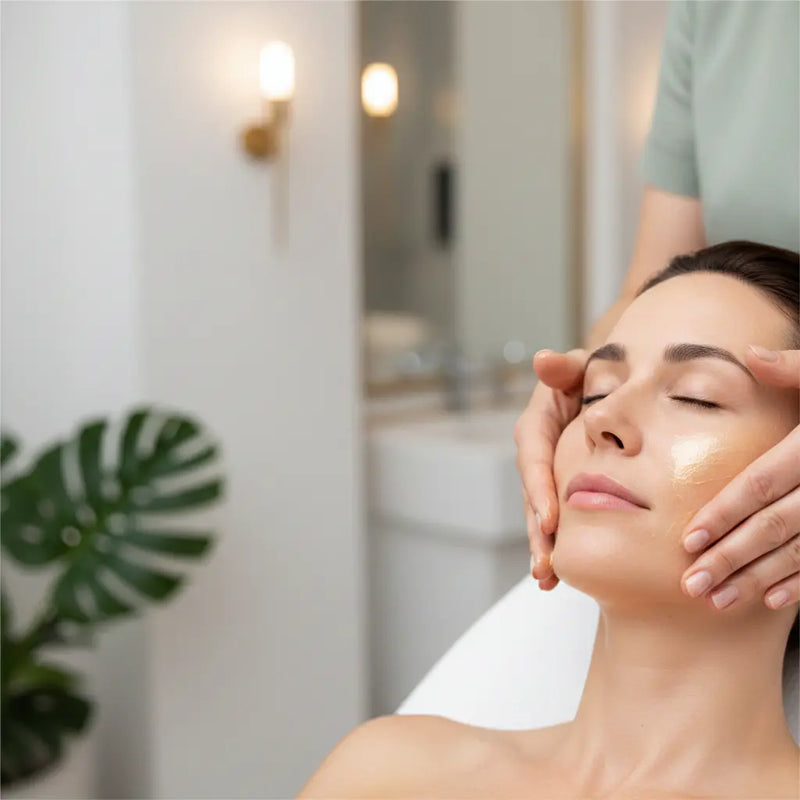
Then the treatment is built around what the skin can handle well. A clinic-grade facial may include cleansing, controlled exfoliation, and a selected modality such as LED, galvanic, ultrasound, or high-frequency support, followed by barrier-focused finishing products. If the skin looks inflamed or overexposed, intensity should be reduced. Pushing through to match the original plan is how irritation happens.
That judgment call is part of professional care.
At Lumina Skin Sanctuary, the goal is a treatment that feels calm, methodical, and suited to Florida skin. Clients do better with a plan that respects heat, humidity, and cumulative UV exposure than with a one-size-fits-all tightening service. If you want to start with that kind of evaluation, you can book a personalized skin tightening consultation.
Here's a closer look at the treatment environment and approach:
Florida aftercare that matters
Aftercare in Southwest Florida needs to account for climate. Heat, humidity, and intense UV can shorten the benefit of a treatment if the skin goes straight back into long outdoor exposure or harsh active products.
A few habits make the biggest difference:
- Use daily SPF: Consistent protection is important for freshly treated skin, even on cloudy days and even if most of the day is spent driving between errands.
- Keep the barrier calm: After a tightening facial, pause strong exfoliants, scrubs, and aggressive at-home acids unless your provider tells you otherwise.
- Respect heat exposure: Beach time, midday sun, saunas, and heavy sweating too soon after treatment can increase redness and irritation.
- Choose hydration you will wear: In humid weather, heavy creams can feel uncomfortable. A lighter barrier-supporting formula is often the better fit.
With non-invasive tightening treatments, downtime is usually limited to temporary warmth, mild redness, or slight swelling. Many clients return to normal routines quickly, but Florida conditions still call for restraint in the first day or two. Simple aftercare tends to work best because people follow it.
Freshly treated Florida skin responds best to gentle cleansing, barrier support, and disciplined sun protection. Those basics usually preserve results better than an overloaded home routine.
Find Your Perfect Treatment and Book Your Transformation
If you're searching for a skin tightening facial near me, the best match depends on what you see in the mirror most often. If your main issue is early laxity and contour softness, a structured firming treatment or series usually makes sense. If sunspots, uneven tone, and rough texture are making the skin look older, brightening and resurfacing may need to come first or happen alongside tightening.
A few final questions tend to come up before booking.
How many sessions will I need? It depends on the degree of laxity, the condition of your barrier, and the modality used. Some people do well with periodic maintenance, while others benefit from a planned series.
Is there downtime? Non-invasive radiofrequency options are commonly chosen because results can continue improving over a 6-to-12-month period post-treatment and they offer a non-painful alternative to surgical facelifts without downtime or swelling, according to this overview of radiofrequency skin tightening outcomes.
Will it look natural? Usually, yes, when the treatment plan is realistic and the provider doesn't overpromise. The goal is firmer, healthier-looking skin, not a drastic change.
When you're ready for a personalized plan, book directly through the Lumina appointment page.
If your skin is showing the effects of Southwest Florida sun, heat, and humidity, Lumina Skin Sanctuary offers clinic-grade facial care built around realistic tightening goals, barrier support, and climate-adaptive aftercare.


