

How Facial Frequency Affects Skin Results in 2026
DavidTL;DR:
- Facial treatment frequency should align with the skin’s 28–40 day natural turnover cycle to maximize results. Adjust schedules based on skin type, age, environment, and treatment intensity, prioritizing consistency over frequency. In humid climates like Fort Myers, gentler, spaced treatments better support the skin barrier and prevent congestion.
Facial treatment frequency is defined as the rate at which professional skin treatments are scheduled relative to the skin’s natural epidermal renewal cycle. How facial frequency affects skin results comes down to one principle: treatments timed to the skin’s 28–40 day cell turnover cycle produce cumulative improvements, while treatments scheduled too close together or too far apart stall progress. Under-treating leaves the skin without consistent stimulus for collagen production. Over-treating damages the barrier and triggers compensatory oil production. Lumina Skin Sanctuary in Fort Myers, Florida, builds every treatment plan around this biological reality, accounting for local humidity and individual skin needs.
How does facial frequency affect skin results?
The skin’s epidermal turnover cycle is the biological clock that determines how often professional treatments deliver their best results. Skin cell turnover ranges from 28 to 40 days depending on age, environment, and skin type. That range is not arbitrary. It reflects how long the skin needs to complete one full renewal cycle before it is ready to respond fully to the next treatment.

Standard professional guidelines recommend facials every 4–6 weeks to align treatments with this cycle. Consistent treatments at this interval stimulate fibroblast activity and collagen remodeling in a way that a single intensive session cannot replicate. The skin builds on each treatment rather than starting over from scratch.
Skin cell turnover slows with age, moving from roughly 28 days in younger adults to 40–50 or more days in mature skin. This means older adults often need slightly longer intervals between sessions, not shorter ones, to allow full recovery and response.
| Age Group | Approximate Turnover Rate | Recommended Frequency |
|---|---|---|
| Teens to 20s | 28–30 days | Every 4 weeks |
| 30s to 40s | 30–40 days | Every 4–6 weeks |
| 50s and above | 40–50+ days | Every 6–8 weeks |
Pro Tip: Patience produces better results than intensity. Consistent monthly treatments outperform sporadic aggressive sessions every time.
How does skin type change the recommended facial frequency?
Skin type is the single biggest variable in facial scheduling. Oily and acne-prone skin responds well to treatments every 2–4 weeks during active breakout phases. More frequent sessions help control congestion, reduce excess sebum, and keep pores clear. A deep purifying pore control treatment is well suited to this schedule.
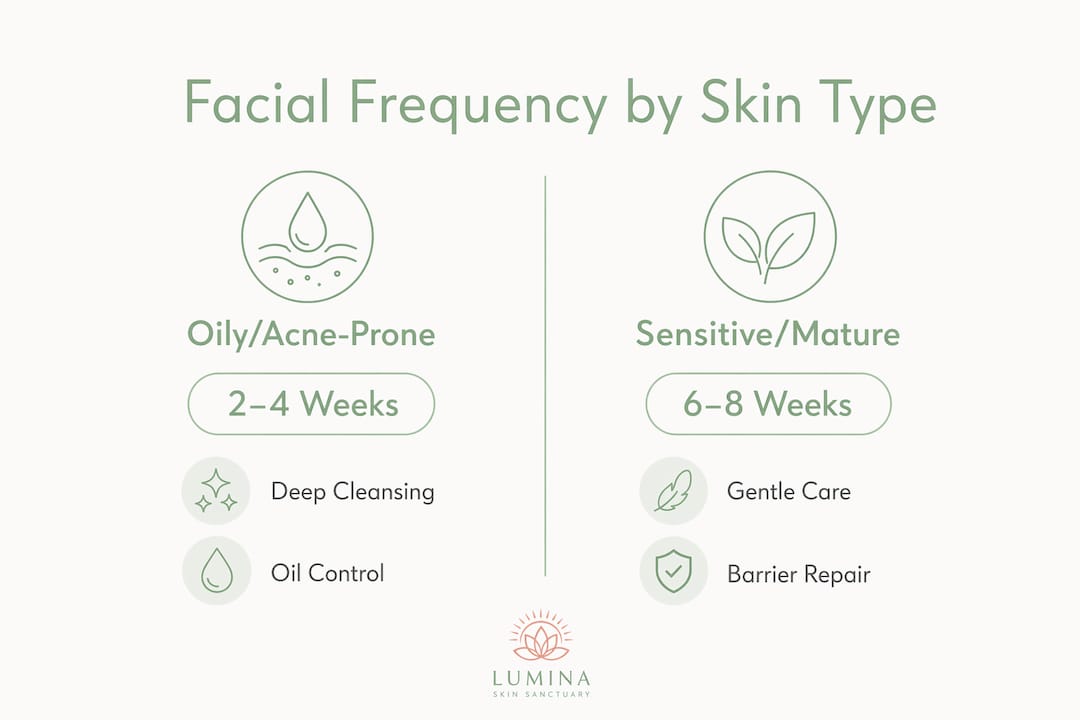
Sensitive, rosacea-prone, or mature skin requires a different approach entirely. These skin types need 6–8 week intervals to allow the barrier to recover fully between sessions. Pushing sensitive skin too hard too fast causes chronic redness and increased reactivity. Guidance on rosacea-prone skin scheduling covers this in detail.
Over-exfoliation is the most common scheduling mistake across all skin types. Over-frequent facials damage the skin barrier, causing chronic redness, heightened sensitivity, and paradoxical acne flare-ups from compensatory sebum production. At least 4 weeks between professional exfoliation sessions is the minimum safe interval for barrier recovery.
| Skin Type | Recommended Frequency | Treatment Focus |
|---|---|---|
| Oily or acne-prone | Every 2–4 weeks | Deep cleansing, pore control |
| Normal or combination | Every 4–6 weeks | Hydration, maintenance |
| Dry or dehydrated | Every 4–6 weeks | Moisture restoration |
| Sensitive or rosacea-prone | Every 6–8 weeks | Barrier support, calming |
| Mature | Every 6–8 weeks | Collagen stimulation, firming |
Pro Tip: Track how your skin looks and feels in the days after each treatment. Persistent tightness, redness, or breakouts are signals to extend the interval, not shorten it.
How does treatment intensity affect scheduling intervals?
Not all facials carry the same recovery demand. A hydrating or lymphatic facial places minimal stress on the skin and can be scheduled every 4 weeks without concern. Aggressive treatments like chemical peels and microneedling are a different category entirely.
Chemical peels and microneedling require 8–12 weeks between sessions for proper recovery. Scheduling these treatments too close together causes chronic redness and irritation that can appear in as little as 4 weeks. The skin needs time to complete its inflammatory response and rebuild before the next session.
The following intervals reflect standard recovery requirements by treatment type:
- Hydrating or lymphatic facials: Every 3–4 weeks. Minimal recovery needed. Safe for most skin types on a consistent schedule.
- Enzyme or mild exfoliating facials: Every 4–6 weeks. Allows full epidermal turnover between sessions.
- Gentle chemical peels (superficial): Every 6–8 weeks. Requires barrier recovery and collagen response time.
- Medium-depth chemical peels: Every 8–12 weeks. Significant post-treatment recovery period.
- Microneedling: Every 8–12 weeks. Collagen remodeling takes 6–8 weeks to complete after each session.
Persistent redness beyond 48 hours post-treatment signals over-treatment and a compromised barrier. That is the clearest sign that the current schedule needs to be extended. Ignoring this signal leads to chronic irritation that is harder to reverse than it is to prevent.
What does humidity in Fort Myers add to facial frequency planning?
Fort Myers, Florida, presents specific skin challenges that change how facial frequency should be planned. High year-round humidity affects the skin barrier, increases oil production, and raises the risk of congestion and breakouts. These effects are not minor. They require a deliberate adjustment to treatment type and scheduling.
Humidity triggers reactive oil production when the skin barrier is stripped too often. Aggressive exfoliation in a humid climate backfires by disrupting the moisture barrier and causing the skin to produce excess sebum in response. The result is more congestion, not less. A skincare routine for humid climates addresses this directly.
Lumina Skin Sanctuary’s approach to humid climate skin care prioritizes barrier maintenance over aggressive correction. Key adjustments for Fort Myers clients include:
- Prioritizing gentle, consistent deep-cleansing treatments over frequent exfoliation
- Spacing exfoliating treatments further apart during peak humidity months
- Using barrier-supporting ingredients between sessions to prevent moisture loss
- Monitoring oil production and congestion as indicators for scheduling adjustments
- Avoiding back-to-back aggressive treatments during periods of high heat and humidity
Gentle cleansing with appropriate frequency is the most effective strategy for humid climate skin. The goal is consistent maintenance, not aggressive correction. This approach keeps the barrier intact while managing the congestion that humidity promotes.
How do you build a sustainable facial treatment schedule?
Consistent facial treatments outperform sporadic or aggressive approaches because steady moderate frequency prevents regression and maintains collagen stimulation. The most common mistake is treating facials as occasional indulgences rather than part of a cumulative strategy. A single intensive session cannot replace months of consistent moderate-frequency care.
A practical schedule follows two phases. During a corrective phase, such as active breakouts or pigmentation treatment, frequency may increase to every 3–4 weeks temporarily. Once goals are met, the schedule transitions to a maintenance phase with gentler treatments every 6–8 weeks. This phased approach prevents long-term irritation while sustaining results.
Use this checklist to evaluate whether your current schedule needs adjustment:
- Skin feels consistently tight, red, or reactive after sessions. Extend the interval.
- Results fade completely before the next appointment. Shorten the interval or add home care.
- Breakouts increase after treatments. Reassess treatment type and frequency.
- Skin looks dull or congested between sessions. Consider adding a gentle cleansing treatment.
- Post-treatment redness lasts longer than 48 hours. Reduce treatment intensity and extend recovery time.
Combining professional treatments with a consistent home care routine extends the results of each session. Professional treatments set the foundation. Daily home care maintains it between appointments.
Key Takeaways
Facial treatment frequency drives long-term skin results by aligning sessions with the skin’s 28–40 day epidermal turnover cycle, skin type, treatment intensity, and environmental factors like humidity.
| Point | Details |
|---|---|
| Align with turnover cycle | Schedule facials every 4–6 weeks to match the skin’s natural 28–40 day renewal rate. |
| Adjust for skin type | Oily skin benefits from every 2–4 weeks; sensitive or mature skin needs every 6–8 weeks. |
| Space aggressive treatments | Chemical peels and microneedling require 8–12 weeks between sessions for full recovery. |
| Account for humidity | In Fort Myers, prioritize gentle cleansing over frequent exfoliation to protect the barrier. |
| Consistency beats intensity | Steady moderate-frequency schedules produce better long-term results than sporadic intensive sessions. |
Frequency planning in humid climates: what I’ve learned
The most persistent mistake I see is clients treating facial frequency as a fixed rule rather than a living plan. They read “every 4 weeks” and follow it regardless of how their skin is actually responding. In Fort Myers, that rigidity causes real problems.
Humidity changes the equation. Skin that handles monthly exfoliating treatments well in a dry climate often becomes reactive and congested on the same schedule here. The barrier is already working harder just to manage the environment. Adding aggressive treatments on top of that stress compounds the problem rather than solving it.
What actually works is a schedule that responds to the skin. During the summer months in Fort Myers, I consistently recommend extending intervals for exfoliating treatments and shifting toward barrier-focused sessions. When clients make that adjustment, their skin stabilizes. When they resist it, they end up chasing inflammation rather than improving their skin.
The other pattern worth naming: clients who abandon their schedule after one difficult reaction. One over-treated session does not mean facials are not working. It means the interval or intensity needs adjustment. Staying consistent, even at a gentler level, always produces better outcomes than stopping entirely.
— Kira Tia
Personalized facial treatments at Lumina Skin Sanctuary
Lumina Skin Sanctuary in Fort Myers offers treatment options built around the principles covered here, from frequency planning to humidity-adapted protocols.
For oily or congested skin, the Deep-Cleansing Acne Facial is designed for active breakout phases and humid climate conditions. For clients focused on firmness and collagen support, the Anti-Aging Firming Facial provides a structured treatment plan aligned with mature skin’s longer recovery intervals. The High-Frequency Add-On is available to enhance sessions for clients managing persistent congestion or acne. Each treatment plan starts with a consultation to match frequency, treatment type, and home care to your skin’s current condition.
FAQ
How often should you get a facial for best results?
Most skin types benefit from facials every 4–6 weeks, aligning with the skin’s natural epidermal turnover cycle. Oily or acne-prone skin may need every 2–4 weeks during active breakout phases.
Does facial frequency improve skin over time?
Yes. Consistent monthly treatments produce cumulative collagen remodeling and fibroblast stimulation that single or infrequent sessions cannot replicate. Regular scheduling prevents regression and maintains skin clarity.
Can you get facials too often?
Over-treating damages the skin barrier and causes chronic redness, increased sensitivity, and acne flare-ups from excess sebum production. A minimum of 4 weeks between professional exfoliation sessions protects barrier integrity.
How does humidity affect how often to get facials?
Humidity increases oil production and congestion, making aggressive exfoliation counterproductive. In humid climates like Fort Myers, gentle and consistent deep-cleansing treatments spaced further apart protect the barrier better than frequent exfoliation.
When should you adjust your facial treatment schedule?
Extend your interval if redness persists beyond 48 hours after a session, or if breakouts increase following treatment. Shorten the interval if results fade completely before your next appointment.