

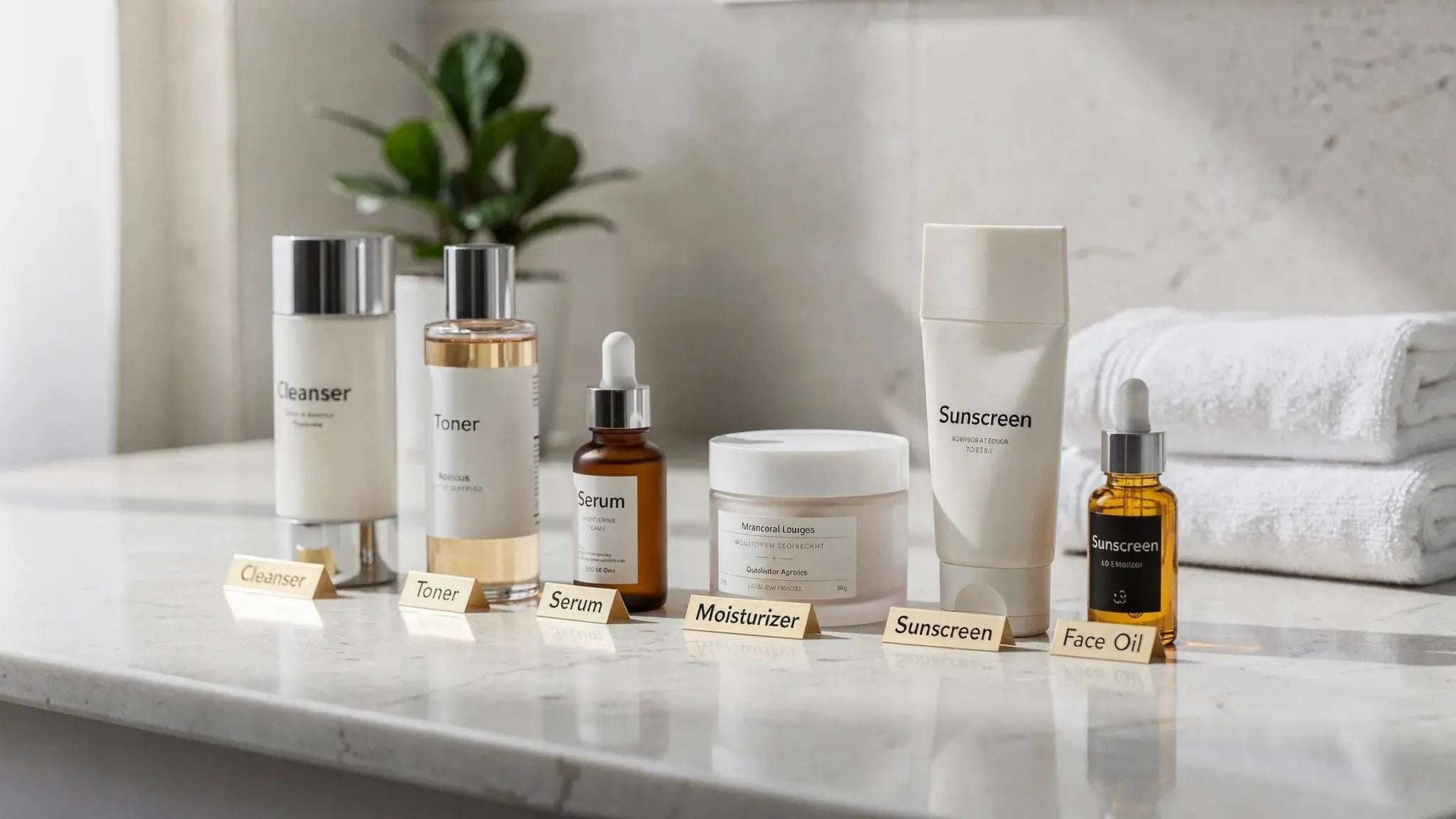
Getting results from skincare is not only about what you use, it is also about the order of skincare products. Layering in the wrong sequence can dilute actives, cause pilling under sunscreen, or trigger irritation that makes you quit a routine that could have worked.
This guide breaks down the correct layering logic (so you can place any product confidently), plus a practical placement chart, skin-type tweaks, and common mistakes we see in real life at Lumina Skin Sanctuary in Babcock Ranch.
Why the order of skincare products matters
Skincare is formulated to sit at different “levels.” Some steps are designed to clean (remove oil and film), some treat (deliver an active ingredient), and some seal and protect (reduce water loss or block UV). If you put a heavy, occlusive product on first, it can reduce the penetration of water-based treatments applied afterward.
Layering also affects comfort. Many irritation issues are not “bad skin,” they are too many strong steps in the wrong order, especially in sunny, humid climates where sweat, sunscreen, and long wear makeup increase the chance of pilling.
The two rules professionals actually use
You will hear “thin to thick,” and it is helpful, but pros rely on two rules:
Rule 1: Function first (cleanse, treat, seal, protect)
- Cleanse: remove debris so treatments contact skin.
- Treat: apply targeted actives (vitamin C, retinoids, acne meds, pigment correctors).
- Seal: moisturizers and oils reduce transepidermal water loss.
- Protect: sunscreen is the final skincare step in the morning.
Rule 2: Texture second (generally, water to oil)
Within the “treat” category, go from lightest to most occlusive, unless a product label instructs otherwise.
The correct layering order (AM and PM)
Below is the most reliable template. Think of it as a framework you can simplify, not a checklist you must max out.
Morning (AM) layering
Goal: antioxidant support + hydration + UV protection.
- Cleanser (or a gentle rinse if you are very dry/sensitive)
- Optional hydrating toner/essence (if you use one)
- Treatment serums (commonly antioxidant or brightening)
- Moisturizer (or a lighter gel-cream if you run oily in humidity)
- Sunscreen (always last)
- Makeup
The American Academy of Dermatology is clear that daily, broad-spectrum sunscreen is a core anti-aging and skin cancer prevention step, and it must be applied as the final layer so it can form an even protective film on the skin (AAD sunscreen guidance).
Night (PM) layering
Goal: remove buildup + repair + use stronger actives when appropriate.
- Makeup removal or first cleanse (especially if you wear water-resistant sunscreen)
- Cleanser
- Optional exfoliant step (not nightly for most people)
- Treatment (retinoid, acne medication, pigment corrector)
- Moisturizer
- Optional occlusive layer (only if you are very dry, irritated, or barrier-compromised)

Where does each product go? (Quick placement chart)
If you are staring at your shelf thinking “Where does this fit?”, use this chart.
| Product type | Goes in this order | Notes that prevent mistakes |
|---|---|---|
| Oil cleanser/balm | 1st cleanse (PM) | Great for dissolving sunscreen and long-wear makeup. Follow with a water-based cleanser. |
| Water-based cleanser | AM step 1, PM step 2 | Choose gentle if you use actives. Over-cleansing can worsen dehydration. |
| Toner/essence | After cleansing | Optional. Helpful for hydration, not required for results. |
| Vitamin C serum | AM treatment | Apply before moisturizer. Pair with sunscreen for best protection benefits. |
| Niacinamide serum | AM or PM treatment | Often plays well with many routines and can support barrier function. |
| Hyaluronic acid serum | AM or PM (after cleansing/toner) | Works best when topped with moisturizer to “seal” hydration. |
| AHA/BHA exfoliant | PM after cleansing | Use on dry skin if directed. Do not stack multiple exfoliants. |
| Retinoid (retinol/retinal/tretinoin) | PM treatment | Apply to dry skin to reduce irritation. Use moisturizer after (or “sandwich” if sensitive). |
| Benzoyl peroxide | Typically PM treatment | Can bleach fabric. Can be drying, use moisturizer. Follow prescriber guidance if Rx. |
| Spot treatment | After serums, before moisturizer (usually) | If it is a hydrocolloid patch, apply to clean, dry skin before creams. |
| Eye cream | Before moisturizer (or with it) | Not mandatory, but helpful if formulated for your concern. |
| Moisturizer | After treatments | Gel for oily climates, richer creams for barrier support. |
| Face oil | After moisturizer | Oils are sealing steps, not hydrating steps. |
| Occlusive balm/petrolatum | Last step (PM only) | Useful for irritation or very dry areas. Avoid if acne-prone unless advised. |
| Sunscreen | Last step (AM) | Let moisturizer settle, then apply sunscreen generously. |
| Makeup/primer | After sunscreen | If pilling happens, adjust layers, not just product amounts. |
Key exceptions (the “don’t mess with this” rules)
Layering is flexible, but a few exceptions matter.
1) Sunscreen is always last in the morning
Even great serums cannot compensate for UV exposure. In Florida sun, consistency matters more than complexity.
2) Prescription instructions override general layering
If you use prescription acne or pigment treatments, follow your clinician’s direction. Some prescriptions are meant for bare, dry skin, others can be buffered with moisturizer.
3) Do not stack too many strong actives in one routine
Common irritation combos (especially for beginners) include:
- AHA/BHA exfoliants + retinoids in the same night
- Multiple exfoliants (toner + serum + mask)
- Benzoyl peroxide + strong retinoids without a barrier-support plan
If your skin feels stingy, tight, or looks shiny in a “too stripped” way, simplify for 1 to 2 weeks and rebuild.
How to layer for your skin type (especially in humidity)
“Correct order” should still feel good on your skin. Here is how we typically adjust routines for the Babcock Ranch lifestyle.
Oily, congested, or acne-prone
Keep layers light in the morning so sunscreen sits well.
A practical approach:
- Use a gentle cleanser (avoid harsh scrubs)
- Choose one treatment step (for example, niacinamide or an acne treatment)
- Use a lightweight moisturizer only if needed
- Apply sunscreen and stop
At night, prioritize thorough cleansing and a single acne or texture treatment, then moisturize.
Dry, dehydrated, or “tight but oily” (common with air conditioning)
Many people are oily on the surface but dehydrated underneath.
What helps:
- Add a hydrating layer (toner/essence or hyaluronic acid serum)
- Always follow water-based hydration with moisturizer
- Consider a thin occlusive layer on dry areas at night (not all over if you clog easily)
Sensitive, reactive, or redness-prone
Your best routine is the one that does not inflame the barrier.
General principles:
- Fewer steps, fewer actives
- Avoid frequent exfoliation
- Introduce new products one at a time and patch test
If you suspect rosacea or dermatitis, it is worth getting professional guidance instead of experimenting.
Pilling, sticky sunscreen, and other layering problems (and how to fix them)
Pilling is usually a formulation conflict, an application issue, or too many layers.
Most common causes
- Applying products too quickly, before the previous layer sets
- Using too much of multiple leave-on products
- Layering several silicone-heavy formulas (often primers, some sunscreens, some moisturizers)
- Rubbing instead of gently pressing sunscreen over skincare
Simple fixes that work
- Apply less product per layer, then add only where needed
- Wait 30 to 60 seconds between serum and moisturizer
- Switch one layer to a lighter texture (often the moisturizer)
- If your sunscreen pills, try applying it in two thin coats rather than one thick rub-in

A quick travel note: keep your order, simplify the routine
Travel often triggers breakouts or irritation because routines change, humidity shifts, and sunscreen use increases.
If you are packing for a trip, keep your “core four” in the same order:
- Cleanser
- One treatment (or none if your skin is reactive)
- Moisturizer
- Sunscreen
When your routine is “right” but your skin is still not improving
Correct layering is powerful, but it cannot solve everything by itself. Consider a professional consult if you have:
- Persistent acne (especially cystic or painful)
- Pigmentation that keeps returning (sun, melasma, post-acne marks)
- Chronic sensitivity, burning, or flaking
- Texture that does not budge with gentle home care
In-clinic treatments (facials, chemical peels, and non-invasive rejuvenation) can reset congestion, support the barrier, and help you choose home care that actually matches your skin.
Frequently Asked Questions
What is the correct order of skincare products? Cleanse first, apply treatments on clean skin, seal with moisturizer, and finish with sunscreen in the morning. At night, cleanse thoroughly, treat, then moisturize.
Do I really need toner before serum? Not necessarily. Toner is optional unless it serves a purpose for you (hydration, comfort, prepping for serums). Results come more from consistent treatment + sunscreen than from extra steps.
Should I apply hyaluronic acid before or after moisturizer? Before. Hyaluronic acid is a water-based hydrator, so apply it after cleansing (or toner), then follow with moisturizer to seal it in.
Where do face oils go in the routine? After moisturizer (usually at night). Oils act as sealing layers, so they typically go near the end.
How long should I wait between skincare layers? There is no universal rule, but 30 to 60 seconds between layers helps reduce pilling. For sunscreen, allow moisturizer to settle, then apply sunscreen evenly.
Can I use vitamin C and retinol together? Many people use vitamin C in the morning and a retinoid at night to minimize irritation. If you want both in one routine, get individualized guidance because sensitivity varies.
Why does my sunscreen pill when I layer products underneath? Common causes include too many layers, applying too much product, or incompatible textures (for example, silicone-heavy products stacked). Simplifying one layer usually fixes it.
Ready for a routine that actually fits your skin?
If you want help dialing in the order of skincare products for your goals (and for Southwest Florida’s sun and humidity), Lumina Skin Sanctuary offers consultation-led care and customized facials designed to support healthy, radiant skin.
Explore Lumina Skin Sanctuary at luminaskinsanctuary.com and book a consultation when you are ready for a personalized plan.


